

WW Partners®

WW Partners®

(801) 312-9122
  • Litigation
    • Business Litigation
    • Commercial Debt Litigation
    • Contract Disputes
    • Intellectual Property Right Infringement
    • Product Litigation
  • Transactional
    • Business Law
    • Construction Law
    • Real Estate Law
    • Creditor Rights
    • Intellectual Property
    • Securities Law
  • Estate Planning
    • Wills & Testamentary Documents
      • Codicils: Changing a Will
    • Trusts
      • Revocable Living Trusts
      • Irrevocable Trusts
      • Special Needs Trusts
      • Asset Protection Trusts
    • Probate And Estate Administrator
    • Power of Attorney & Healthcare
    • Elder Law
    • Guardianship Designations
    • Business Succession
    • Tax Planning
    • Charitable Giving
  • About
    • Reviews
    • News & Updates
  • Contact Us

The Difference Between Trademark and Copyright Infringement 

Home | Archives for Max | Page 4

difference between copyright and trademark infringement

There is often confusion around the differences between trademarks and copyright, but they are in fact two different legal concepts that protect different property. Protecting your intellectual property is important, no matter what industry you are in. When someone violates your rights, takes your property, or participates in copyright infringement on your intellectual property, they may face different penalties depending on whether you have established a trademark or a copyright.

Working with business lawyers when it comes to intellectual property and trademarks will save your business from irreversible damage. WW Partners knows the ins and outs of trademark and copyright infringement, so this blog will provide insight into how the two protections differ and how infringement is handled.

What Is Copyright?

Copyright is a legal protection granted to the original creators of a tangible work, like music, photographs, film, and software. When it comes to copyright protection, the creator will have exclusive rights to reproduce and distribute the work for financial gain. When you have copyright protection, you can perform or reprint your works for financial gain without consequence. If someone reproduces your work or tries to profit from your original idea, you can seek legal action. 

What Is A Trademark?

A distinctive sign or symbol that companies attach to their product or services will help them to be easily identified. Trademarks are often attached to logos, brand names, and other unique identifiers, like a character. Trademarks help to save a brand’s reputation and prevent confusion over the quality or type of product for consumers. When someone steals your trademark or tries to replicate your project, people will know that it is not the original because of the missing brand colors, font, or characters. Competitors won’t be able to steal your customers when you have a trademark in place.

Examples Of Infringement

Before you can take legal action, if you believe that your work or creation has been infringed on, it is important to look at examples of both types. Common examples of copyright infringement include:

  • Downloading music without paying
  • Pirating movies
  • Selling copyrighted artwork
  • Plagiarizing articles, books, or blogs
  • Posting stolen images on your social media
  • Sampling part of a song or musical without proper licensing
  • Making and distributing copies of TV programs or radio

Popular examples of trademark infringement include:

  • Confusingly similar names
  • Copying a logo or using a similar pattern in your logo
  • Use the prefix of a trademark (Mc for items from McDonald’s)
  • Mimicking a brand’s well-known name or product

Are Infrigements Addressed Through Lawsuits?
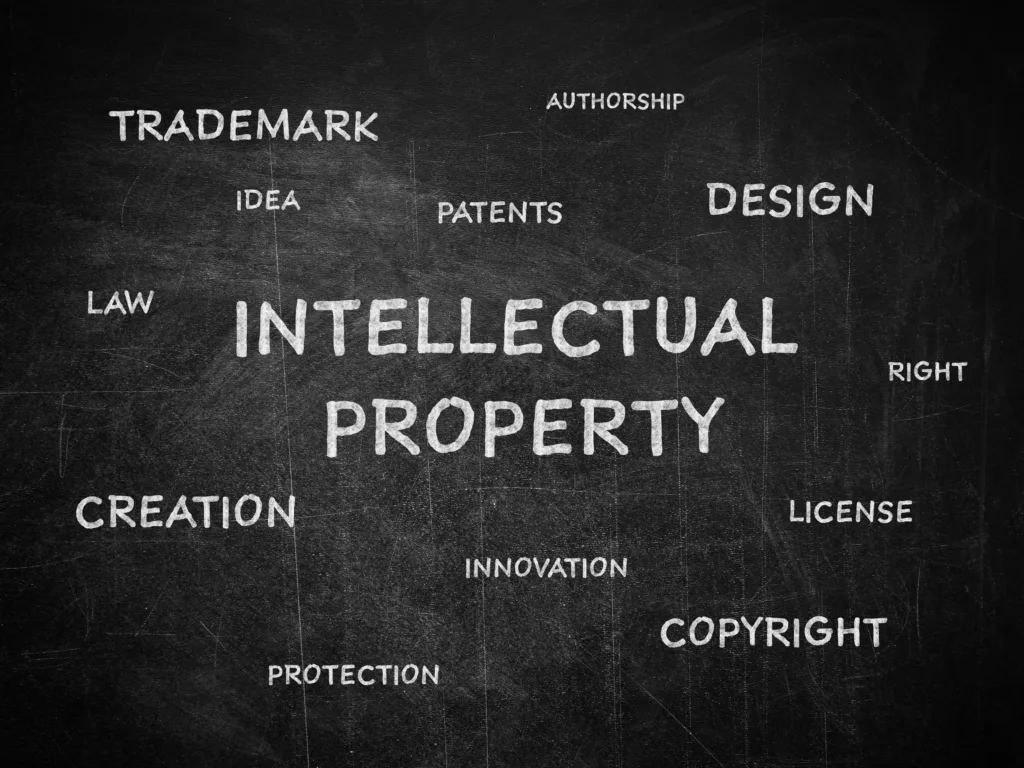
Intellectual Property and other words on blackboard

The first step if you suspect you have experienced infringement is to send a cease and desist letter to the infringing party. This often saves you the money and time that comes from seeking a legal case, and gives the infringer the ability to stop their illegal activity calmly and quietly. However, if an infringing party pushes back or the resale has spread far and wide, you may need to seek litigation. 

Proof Of Infringement

If you want to take a competing company to court for stealing your work or creating something too similar to your idea, you will need proof. Not only will you need proof of the infringement, but you will also have to provide documentation that shows you own the trademark or have copyright privileges of the original piece. Before taking your case to court, proof of the infringement, proof of copying and distribution, or proof of the likelihood of consumer confusion should be gathered.

Trademark And Copyright Help From WW Partners

WW Partners can help you deal with copyright and trademark infringement that comes from selling your products or services. Our team can help you navigate the litigation process and help you understand the legal jargon that comes with it. Our legal experts will prevent damage to your reputation and loss of revenue by providing dedicated support through every step of the process.


WW Partners serves the community of Salt Lake City to help protect their businesses and intellectual property. If you need to register a trademark or are dealing with stolen copyright, we have the industry knowledge to help you get a successful result from your legal case. Fill out our contact form to get started.

Filed Under: Business Law

documentation in business litigation

Business litigation cases need to have quality documentation and evidence in order to be successful. If you want to present a strong defense and help your legal team get the best settlement possible, collecting proper documentation is the best way to do so. In business disputes, courts will need evidence and paper trails when trying to determine who is at fault. Building a stronger case can be done when you keep documentation from the start. 

Even if you don’t believe your business will ever be in a legal dispute, documentation of employees, financial records, and client interactions can save your company. Let’s look at some of the best types of documentation to keep on hand and how they impact your business litigation case. 

Different Types Of Evidence

It is important to gather evidence and documentation, but gathering the right evidence is the only way to have a successful business litigation case. Below are some of the most important documents you can bring to the table when pursuing litigation. 

Financial Records

Bank statements, invoices, and other financial data from all members of the company can be useful in business litigation. Financial records are very telling when it comes to disputes. It is often financial records that point to problems in a company, so keeping bank statements, client payments, payroll records, and a breakdown of your income can prove favorable.

Contracts

Signed contracts are important for business, so keeping them after a deal or transaction is complete may not seem obvious, but keeping them for your records is important for potential business litigation. Any formal agreement will outline what service is offered or how a situation like this will be handled. Contracts from the past are essential evidence for business litigation.

Intellectual Property

Patents, copyrights, or other documentation of intellectual property will be concrete evidence against another party if they try to steal your creative works. Filing proper paperwork for intellectual property will help keep all of your hard work safe. 

Formal Complaints

Records of complaints or in-person disputes at your company can shed light on who is being truthful in a legal dispute. Prior resolutions or mediation should also be documented in order to show that your company takes problems seriously. 

Establishing Factual Credibility

Business Lawyers in Sandy Utah

Documentation is the best way to build a timeline and trust in a party’s narrative. Judges or courts will not be interested in speculation, so having concrete written evidence will show your version of events in a good light. Well-documented business dealings will show clarity, honesty, and keep the focus on facts. 

While business owners may claim they do everything by the book, it is more important to prove it. Contracts, documents, messages, and finances need to be put out in the open if you want to make the case harder to dispute.

Proving Intent

Intent is often the most challenging thing to prove in a business litigation case. Intent, especially in fraud, misrepresentation, or breach of contract cases, is important for the courts to determine who to provide a settlement to. Honest mistakes or misrepresentations can be hard to see in basic arguments. Even when a party denies wrongdoing, documents will be able to show inconsistencies and the true character of a person. Showing consistent behaviors and communication is essential when presenting documentation in a business litigation. 

Persuading The Courts

Strong documentation can deter baseless claims or lies from clouding the judgment of jurors or a judge. Evidence of any kind should be given to your legal team with plenty of notice in order for them to build a case against those who are pointing the finger at you. Even if you think something may not be important, it should be given to your legal team to keep everything about your company out in the open.

Documents will be presented and dissected by both legal teams to show the many different sides of the story. Persuading the courts can be much easier when you have documentation of every single process your business conducts. 

Legal Experts At WW Partners

WW Partners is Utah’s top choice for business litigation, intellectual property law, and contract disputes. Our legal team has years of experience working on complex legal cases with a client-focused approach. Our lawyers have detailed knowledge of a variety of issues so that you can feel confident about the final outcome of your legal case. Let our lawyers tackle your legal challenges with confidence. Schedule a consultation with us to get started.

Filed Under: Business Law

protect your business from online IP theft

Intellectual Property is creations of the mind, including inventions, art, symbols, graphic design, written works, and more. These pieces of property are often found in businesses and need to be protected to save you from costly legal fees. IP has laws surrounding it, but it can often be hard to prevent IP theft when you are a smaller organization or fully based online. IP theft can damage a reputation, undermine economic growth, and cause you to lose out on time and money you spent creating these pieces. 

It is important for businesses to check in on their online intellectual property frequently if they want to protect their business from IP theft. The increase in digital technology has made it easier for hackers to steal creative works and pass them off as their own. This blog will share some ideas on how to protect your intellectual property and ensure your livelihood is safe. 

Make Sure Ownership Of IP Is In Order

Ensuring the ownership of your intellectual property is in order is the best way to protect yourself from IP theft. Setting up contracts with employees or partners stating that the work is yours and having them sign will help if something does get stolen. Reviewing who has access to the property will also help avoid theft from unauthorized users. Making legal agreements with clarity on who the property owner is can be done before any copyright or trademarks are registered. 

Use Encryption

Encryption is your best friend when it comes to intellectual property. Encrypting stored data, files shared in your organization, or messages about property creation will lower the risk of online IP theft. While extreme hackers could get around your encryption wall, it does help stop lesser threats from accessing your creative works. Protection for information that flows into the cyberworld in order to be created is one major area that benefits from encryption. Make sure to set up encryption for all communications and correspondence, not just the important ones. 

Do A Cybersecurity Audit

Every so often, it can be helpful to conduct an audit throughout your business. During an audit, make sure to look at what parts of your company have the highest breach risk. Looking at multiple cybersecurity platforms and safety perimeters can be time-consuming, but it is worthwhile if you want to find digital weaknesses that could lead to IP theft. During an audit, look at what needs to be mediated first and what is the highest risk to your business. Simply changing passwords or avoiding sketchy email attachments isn’t enough to prevent cyber breaches anymore. 

Utilize Threat Modeling

Oftentimes, the best way to overcome a problem is to look at every outcome, negative and positive. Threat modeling can be a way for businesses to adjust their security measures around online IP theft. Modeling a threat looks like this: pretending to or creating an artificial threat to see how far a hacker could get and what they could access. Penetration testing or threat modeling shouldn’t be done by just anyone, but looking for weak points in your system can be easily done this way. It is also important to see how easily company electronics, employee data, and corporate information could be accessed while doing these checks. 

How To Protect Your Business From Online IP Theft

Educate Employees

While many of us have been online for years now, it can be difficult to understand the level of security and scrutiny that companies go through to protect their creative process. Humans are often the reason for online security breaches because we make errors quite frequently. As a business, it is important to train employees about the dangers of online IP theft and what not to do while working for your company. Using VPNs, keeping company secrets or insight classified, and anti-phishing training are all good places to start with employees. Preventing online IP theft is possible when your entire team is on board.

The Effects Of Online IP Theft

The ripple effects of intellectual property theft can be substantial, especially if you have an online breach that you are unable to track. When someone steals your intellectual property, it can lead to intense legal proceedings, lawyer fees, and even cost you your hard work on the project. 

Those who steal intellectual works and creative processes are undermining the economic growth and stability of our society. Taking away creativity, failing to formulate new ideas, and creating counterfeit products can damage more than just one company’s reputation. By lowering the cost of a creative work by creating a lower quality product, the market becomes oversaturated, and prices are ultimately affected for years to come. 

Other negative side effects of online IP theft include:

  • Job loss
  • Health and safety risks for consumers
  • Damage to your brand image
  • Lower incentive to create
  • Reduced market opportunities
  • Lower quality items and products
  • Leak of personal and financial information

IP Lawyers From WW Partners

Our legal team can help you with intellectual property, business management, and much more. Our lawyers are well-versed in the law and can help businesses and individuals get their desired results in a legal case. Reach out to WW Partners if you have been a victim of IP theft or another criminal act.

Filed Under: News

  • « Previous Page
  • 1
  • 2
  • 3
  • 4
  • 5
  • Next Page »

Hours

WW Partners®

8941 S 700 E, Suite 200
Sandy, UT 84094

(801) 312-9122

Directions

2026 WW Partners® | All Rights Reserved | Privacy Policy | Terms | XML Sitemap | Sitemap | Site by PDM